Midlife is a wonderful time for reflection. We’ve made it here. We’re looking back at where we came from and ahead to what’s next.

Elizabeth's Blog
Find Calm in the Worry
I find that gratitude and mindfulness practices can complement each other. When I’m mindful of my surroundings I’m also feeling grateful for the things I’m noticing, like the sound of the wind in the tress, or the feeling of my dog’s soft ears, or the way the sun makes shadows on the walls in my home.
When we live in the worry of what was or what might be, we lose touch with where we are right now. Even though things feel out of control or worrisome, a lot of lovely things are happening in this moment. And we miss them when the worry consumes us. So, what can we do to feel more grounded and present in our lives?
But worrying about the bad all the time can color how we see and experience what’s happening right now, too. If we’re stuck in negative thinking, we might not notice an opportunity to get a hug, or the array of colors when the sun sets, or the breeze on our face, or the smell or the earth after a rainstorm, or the warmth of our home after we’ve been outside in the cold.
I experience anxiety, I’m an introvert and I recognized later in life that I’m also a highly sensitive person (HSP), so it’s not surprising that I usually spend a good amount of time alone. With the current physical distancing and stay-at-home restrictions here in my home state of Maryland, the pace of my days is a little slower and I’m spending even more time at home.
About 15 years ago, I got stopped in my tracks. I’d been so busy taking care of others: the kids, the animals, the house, schoolwork, the chores…. Suddenly I realized I was missing something. I felt disconnected, untethered.
I was so out of touch with what I needed and wanted that I would freeze when given a choice like “pizza or Chinese?”

We work so hard to get things done, to check them off our list(s), to be productive that we forget to notice what it’s like to live our life.
We make “doing” a priority.
Then the universe shows up and says, “What if doing isn’t enough? Wouldn’t you like to be in your life instead of do your life?”
“You were born worthy of love and belonging. Courage and daring are coursing through your veins. You were made to live and love with your whole heart. It’s time to show up and be seen.”
About 15 years ago, I got stopped in my tracks. I’d been so busy taking care of others: the kids, the animals, the house, schoolwork, the chores…. Suddenly I realized I was missing something. I felt disconnected, untethered.
I was so out of touch with what I needed and wanted that I would freeze when given a choice like “pizza or Chinese?”
That’s when I started on my journey with a mindfulness and meditation practice. It wasn’t easy. I wasn’t used to sitting quietly or taking notice of my sensory experience. I can remember telling my meditation coach, “I find that I tune out. I daydream, get lost in thought. I don’t think I’m meditating right.”
I worried that I might never get it “right.”

What it’s taken me some time to recognize is that it’s the noticing—when we’re drawn away to our thoughts, feelings, daydreams— that’s what matters. When we’re noticing and coming back to our breath and our body’s sensory experience, we’re practicing mindfulness.
The continued practice has helped me gain new insight into Me. It’s helped me feel more love and connection to all of me. All. Of. Me. The shadow and the light, the imperfections and the gifts. All of me.
It’s also helped me to feel more connected to everyone around me. My kids, my husband, my family, my dog, my clients, people I encounter in daily life…Because I feel a deeper connection inside me, it shines through on the outside.
Imagine if we could all show up and be seen.
I’m on a quest to make that happen! Come join me and women like us in the Women’s Mindfulness Circles that are starting next month!
Here’s what others have said about the Mindfulness Circles:
“Spending time with other women in a supportive, healthy environment, I realized how little I have that.”
“A chance to meet with other [women] who are experiencing similar challenges and be accountable to the group for trying new habits and practices.”
“[I enjoyed] sharing and talking about our experiences.”
What to know more? You can find it here.
If you enjoyed this blog post and would like more insights into living with anxiety, tune into the Woman Worriers podcast. In each weekly 30-minute episode, host Elizabeth Cush, LCPC, and her guests explore living with anxiety, relationships, parenting, surviving trauma and other topics and offer insights into mindfulness, meditation and other helpful resources.
Elizabeth Cush, LCPC is a therapist, blogger, creator and host of the Woman Worriers podcast, and the owner of Progression Counseling in Annapolis, Md and she’s been featured in these major publications. Elizabeth helps busy, overwhelmed men and women manage their anxiety and stress so they can live their lives with more ease, contentment and purpose. If you'd like to know more about how individual, online and group therapy can help ease anxiety and stress, contact me!

Whether you’re celebrating a holiday or not, this time of year can feel really stressful. You usually see signs of Christmas everywhere you go. The music, the ads, the decorations can all feel like a little too much—or maybe a lot too much!
You might not be feeling much of the holiday spirit. This time of year can bring up painful memories and feelings of loss, loneliness and sorrow. If the holidays are difficult for you, know that you’re not alone. Although it might feel like the whole world is having a great time and you’re the only one not filled with holiday joy, know that others are struggling, too.
“We can only be said to be alive in those moments when our hearts are conscious of our treasures.”
Mindfulness can help you get out of your head where the planning and scheduling, the sadness, the worry, and the distress all live. Mindfulness creates more space and awareness for what’s going on right here, right now. I wrote the blog post Staying Mindful Through the Holidays a couple of years ago because I know how hard it can be when the holidays feel overwhelming.
If the holidays are hard for you, or even if you absolutely love them, take some time to feel whatever it is you’re feeling without judgment. Take some time to be kind and compassionate with yourself.
My wish is that, over the next couple of weeks, you can also find some time to relax, take care of yourself, enjoy the people you love, and find small (and big) moments of gratitude and joy. Here’s another link to the post:
https://www.progressioncounseling.com/blog/staying-mindful-through-the-holidays
My recent podcast episode, How to be Mindful this Holiday Season offers even more tips.
If you enjoyed this blog post and would like more insights into living with anxiety, tune into the Woman Worriers podcast. In each weekly 30-minute episode, host Elizabeth Cush, LCPC, and her guests explore living with anxiety, relationships, parenting, surviving trauma and other topics and offer insights into mindfulness, meditation and other helpful resources.
Elizabeth Cush, LCPC is a therapist, blogger, creator and host of the Woman Worriers podcast, and the owner of Progression Counseling in Annapolis, Md and she’s been featured in these major publications. Elizabeth helps busy, overwhelmed men and women manage their anxiety and stress so they can live their lives with more ease, contentment and purpose. If you'd like to know more about how individual, online and group therapy can help ease anxiety and stress call me 410-339-1979.

Between working, preparing for the holidays, maybe taking care of family or friends and doing the everyday things that need to get done, chances are you haven’t been doing a great job of taking care of yourself.
Sometimes we’re so used to caring for others that we’re not fully aware that we’re neglecting ourselves. How do we know we’re not taking good care of ourselves? Here are a few signs that it’s time to give yourself the gift of some self-care—and some suggestions for how to do it.
1. You’re exhausted all the time.
It’s normal to feel more tired than usual during the holidays, when we’re extra busy—but if you’re having a hard time getting out of bed or staying awake throughout the day, you might be over-stressing your system.
Our body and brain need rest to reset each day. If you’re not sleeping well, try taking some time to rest. Lying down for 10-15 minutes without doing anything—even if you don’t sleep—can help your body recharge.
2. You hate the holiday season.
For some of us, the holiday season isn’t filled with joy and laughter. Maybe your memories of past holidays weren’t great, or maybe the idea of seeing some family members leaves you feeling stressed. Whatever the reason, it’s okay not to love this time of year, but it’s all the more reason to do things that you do enjoy! Take some time to watch a movie, listen to music, prepare a good meal, travel, hang with friends or take a walk in nature. Do things that nourish you.
If you do have to spend time with people who leave you feeling less than joyful, set some limits on how much time you need to be there. Maybe have separate transportation so you can leave when you’re ready. Maybe you stay for one day instead of a whole week. Think ahead and remind yourself that setting limits can be very healthy and good for us!
3. You frequently feel resentment, anger or frustration this time of year.
If you’re the kind of person who always puts other people’s needs ahead of your own, if you’re a people pleaser or a constant caregiver, the holidays can bring up a lot of stuff! We can get overwhelmed easily and feel resentful and underappreciated. Life is busy enough without the holidays, so adding more to the to-do list can feel like a burden.
People pleasers and people who gravitate toward caregiving for others often have a hard time asking for help, taking time for themselves and saying “no.” But when there’s so much to do this time of year, the best way you can care for yourself is to set some realistic limits on your time and energy. Take some time to consider how you can support yourself. Don’t say “yes” right away. Pause and ask yourself if this next thing will over-stress you. Could family or friends help with whatever needs doing?
What’s are your clues that tell you it’s time to tune in to yourself? You can give yourself so many gifts:

Paying attention to your needs
Taking time to rest
Nourishing your body
Doing the things you love
Setting boundaries
Asking for help when possible
You also can check out more ways to manage holiday stress on episode 83 of the podcast.
Here’s hoping your holiday is filled with whatever self-care you need!

Decluttering is all the rage. If you have Netflix, I’m sure you’re aware of the show Tidying Up With Marie Kondo. They’re promoting it like crazy! Ms. Kondo also has a book about decluttering called Spark Joy. In both she encourages you to get rid of the things in your life and your home that no longer—or maybe never did—bring you joy.
This week on the Woman Worriers podcast I spoke with Vidyamala Burch about her book, Mindfulness For Women: Declutter Your Mind, Simplify Your Life. We talked about how by choosing to place our attention in our bodies through mindful activities, we’re choosing not to get caught up in the worry, planning and negative thoughts that clutter our minds.
Ms. Burch also shares her experience with mindfulness and why she believes it’s so important for women to bring more mindfulness in to their daily lives.
Last week on the podcast I shared three nature-based strategies to help you be more mindful in daily life. And next week I talk with, Mari Lee, from Growth Counseling Services and The Mindfulness Academy For Addiction and Trauma Training, about why finding a therapist who’s been trained in mindfulness and trauma therapy is so important.
Imagine what it would be like to declutter your mind. What might you discard? Maybe you’d get rid of racing thoughts, constant worrying, ruminating, judging others, judging self, memories of all the things you might have done differently…. The list could go on and on.
What would remain? If you pay attention and focus on the present moment, what brings you joy or a sense of awe? Sunlight shining through a window? A child’s laughter? A favorite song or piece of music?
What helps you feel more grounded, calm or settled? Being with or petting your dog, cat or horse? A warm blanket? Your feet on the floor? When our thoughts and worries take over, we might miss all of these experiences.
Being caught up in worries and fears makes our brain think we’re under attack. It jumps into fight/flight mode. We feel anxious, and our fears and worries intensify. It’s a vicious cycle. And it’s hard to come back down.
When we practice mindfulness, we begin to notice how often we’re caught up in the clutter of our minds. Rehashing, retelling, re-worrying. Each time we find that we’re caught up in thought and worry, we can choose to shift our attention to the things that are happening right now.
Here’s a quick example:

The worry: “Oh no. We leave for our trip tomorrow. The Weather Channel says it might rain while we’re there. Should I bring my raincoat? What if I bring it and it doesn’t rain? Then I took up all that space in my suitcase for nothing. What if it rains the whole time? That would be terrible. The trip would be such a waste of time away. Just stuck in the rain everywhere we go. I wouldn’t have any fun and I’d come home from the trip more stressed than I am now.”
Mindfulness in action: “As I notice where my thoughts have taken me, I can pause and say to myself, ‘Wow! I just recognized that I’m caught up in my worries again and it’s making me really stressed out!’ I can take a slow, deep breath right now to help me tune into my body.
“Instead of getting caught up in the worry, I can choose to pay attention to what’s happening right now, where I am. So instead of being in my head, I can pay attention to folding this sweater for the trip. I can feel the softness of the fabric and I can see its beautiful texture. As I hold it closer to my face I can smell its clean scent. As I move about the room gathering my stuff, I can choose to notice how tense my shoulders and back are. I can breathe into that tension and notice if it changes.
“I can remind myself that I can’t predict the future, but I’d like to be prepared, so I gather my raincoat from the closet. I notice the sounds the fabric makes as I zip the zipper and fold it to fit into my suitcase.”
A mindfulness practice can help you declutter your mind. Focusing your attention on your body and breath will help you come back from runaway thoughts and worries. Mindfulness actually helps to build new neural pathways that allow you to break the cycle of the worry—>fight/flight—>more worry. You might still worry about things you can’t control, but mindfulness helps you to recognize that you have a choice in how you respond to the worry.
Here in Annapolis the Woman Worriers mindfulness groups will begin again this Fall. If you live locally, or in Maryland I’ll be offering in-person and online groups. The groups are designed to support you in your new or ongoing mindfulness practice using meditation and other mindful activities. If you’d like to know more call or email me!
If you enjoyed this blog post and would like more insights into living with anxiety, tune into the Woman Worriers podcast. In each weekly 30-minute episode, host Elizabeth Cush, LCPC, and her guests explore living with anxiety, relationships, parenting, surviving trauma and other topics and offer insights into mindfulness, meditation and other helpful resources.
Elizabeth Cush, LCPC is a therapist, blogger, creator and host of the Woman Worriers podcast, and the owner of Progression Counseling in Annapolis, Md and she’s been featured in these major publications. Elizabeth helps busy, overwhelmed men and women manage their anxiety and stress so they can live their lives with more ease, contentment and purpose. If you'd like to know more about how individual, online and group therapy can help ease anxiety and stress, contact me!

This week I had the pleasure and honor to be interviewed by Tamara Powell about the practice and the power of self-compassion. Tamara’s amazing podcast, Sacred Psychology, uses stories and interviews to take listeners “behind the veil of psychology to a place where neuroscience and spirituality go hand in hand.”
Because of my podcast I interview a lot of people, and I’ve been interviewed before for other podcasts but this time I was feeling some anxiety about this interview. Imposter syndrome snuck up on me and was whispering in my ear that I wasn’t “expert enough” to talk about self-compassion.
As you know I write and talk a lot about bringing more self-compassion in to our lives. The practice has helped me be kinder to myself; it’s helped me to quiet my inner critic and reduce some of my anxiety. So the anxiety over not being “enough” gave me the opportunity to practice what I preach! I took a moment to use my self-compassion tools and I think the interview went really well!
From Tamara’s website: “We do a deep dive on self-compassion: what it looks like, what it takes, problem solving our self-talk and finding some loving truths for ourselves.” I hope you enjoy it!
You can listen to the interview here or here:
Biz’s Blog- Mindful Self-Compassion: How To Be Your Own Best Friend
Woman Worriers Podcast- Elizabeth Cush on Self-Compassion
If you enjoyed this blog post and would like more insights into living with anxiety, tune into the Woman Worriers podcast. In each weekly 30-minute episode, host Elizabeth Cush, LCPC, and her guests explore living with anxiety, relationships, parenting, surviving trauma and other topics and offer insights into mindfulness, meditation and other helpful resources.
Elizabeth Cush, LCPC is a therapist, blogger, creator and host of the Woman Worriers podcast, and the owner of Progression Counseling in Annapolis, Md and she’s been featured in these major publications. Elizabeth helps busy, overwhelmed men and women manage their anxiety and stress so they can live their lives with more ease, contentment and purpose. If you'd like to know more about how individual, online and group therapy can help ease anxiety and stress call me 410-339-1979.
Anxiety often intensifies when your life feels out of control. That’s why a lot of people, myself included, work hard to maintain control. We schedule, we plan, we make lists, we think, we worry…. We imagine all the bad things that might happen and all the potential solutions for when they do.

We might turn toward things that help us forget or ignore the anxiety and stress we’re feeling. For example, we turn to our phone, laptop or iPad for distraction, or stream Netflix shows we’ve already seen. Or we use substances, food or exercise to try to calm down and move the anxiety to a back burner.
All of these behaviors make us feel as though we’re managing our anxiety when we’re probably making it worse. Those behaviors are aimed at ignoring, avoiding or distancing ourselves from the stressed anxious feelings. And the energy we put into not feeling the anxiety can leave us feeling exhausted, unfocused and unmotivated.
Focusing attention on the physical sensations of stress—a racing heart, shortness of breath, chest tightness, a stomachache or headache—is another unconscious strategy for avoiding anxious feelings. We put our physical health foremost in our minds instead of the difficult feelings. Again, we are probably making our anxiety worse!
Often the source of the stress and anxiety lie beneath the surface. Even though we’re not aware of what lies in our unconscious, we know we feel uncomfortable—and we don’t like discomfort. We want it to go away!
I’ve struggled a lot through the years when I felt like things were out of control and in this week’s episode of the Woman Worriers podcast I share my experience with managing my anxiety in the moment when things didn’t go as planned.

When I was a young mom, my anxiety centered on knowing what was next. I made lists. I’d plan lunch, dinner and the kids’ activities. I’d need to know what time we were leaving to go wherever it was we were going. I’d want to know who would be there. I think I drove my husband a little crazy! The problems came when the “plans” didn’t go as planned. Maybe a child got sick, or the car wouldn’t start or my husband got stuck at work. Suddenly I would be filled with anxiety because we couldn’t stick to the plan. My anxiety would come out as irritability or anger. I’d snap at those closest to me.
The anger and irritability were easier than the emotional pain I was feeling. I focused so much of my energy on taking care of everyone else’s needs that I often felt unseen, resentful and under-appreciated. But those feelings were buried below the surface, and I rarely expressed them to myself or anyone else.
Unfortunately all of the ways we try to put off or avoid feeling the discomfort only work in the short term, and sometimes they don’t work at all. The anxiety is usually our body’s way of telling us that it’s distressed. We continue to tell it that we don’t care, that we don’t want to hear it or see it or feel it. And so the anxiety and stress don’t go away. They keep coming back.
What I’ve learned over the years through therapy, meditation and a mindfulness practice is that the more I avoid the anxiety, the worse I feel. That turning toward the anxiety, feeling the discomfort and identifying what’s below the surface can actually make you feel better!
I’m not saying that it’s easy, or that change happens overnight. But with effort, practice and mindful attention, we can learn to tune into our feelings and feel them when they surface. We might still have some anxiety, but as we learn to soothe ourselves in difficult moments, we can make feeling our feelings our superpower and keep anxiety in the passenger seat where it belongs.
If you struggle with starting or maintaining a mindfulness practice, and you live in the Annapolis, Md., area individual and group therapy is available to help get you started and keep you going.
If you enjoyed this blog post and would like more insights into living with anxiety, tune into the Woman Worriers podcast. In each weekly 30-minute episode, host Elizabeth Cush, LCPC, and her guests explore living with anxiety, relationships, parenting, surviving trauma and other topics and offer insights into mindfulness, meditation and other helpful resources.
Elizabeth Cush, LCPC is a therapist, blogger, creator and host of the Woman Worriers podcast, and the owner of Progression Counseling in Annapolis, Md and she’s been featured in these major publications. Elizabeth helps busy, overwhelmed men and women manage their anxiety and stress so they can live their lives with more ease, contentment and purpose. If you'd like to know more about how individual, online and group therapy can help ease anxiety and stress, contact me!
Anxiety comes from many sources: old physical and emotional wounds, trauma and childhood emotional neglect, just to name a few. The feelings from these issues are often buried below the surface, and anxiety bubbles up when we feel distressed.
Other times, our anxiety stems from things that are much more tangible, like infertility, miscarriages or medical conditions that we have little control over. On the Woman Worriers podcast these last two weeks, we explored how polycystic ovary syndrome (PCOS) and infertility can impact women’s anxiety, their health and their sense of self. These and other medical conditions can leave us feeling anxious and depressed and can cause strain in our relationships.
We end up feeling like our bodies are the enemy because they’re not conforming to societal and biological norms. Our sense of control and well-being is disrupted when medical conditions impact how we feel about our bodies. These concerns can shake our sense of self and leave us feeling like we no longer “fit-in” or that there’s something “wrong” with us.

Dealing with very personal medical problems is especially hard because talking about them can make us feel uncomfortable and vulnerable. We’re not sure how others will react. We’re not sure if we even want to share what’s happening. We end up feeling isolated and alone. This can be especially the case if, when we seek medical help, the healthcare provider isn’t able to diagnose and treat your condition right away or dismisses your symptoms. That can leave us feeling as though maybe we’re imaging the problem.
I’ve heard stories from women whose physicians told them that their fatigue, their physical pain, or their menstrual cycles wouldn’t be a problem if they’d just loose weight, gain weight, take better care of themselves, not worry so much…. And while all of those things might cause other medical issues, these women had diagnosable conditions that were ignored or the women were blamed for the symptoms by doctors who didn’t take time to listen and look for a cause.
We’re left feeling like it’s all in our head, or our body is the problem. If it would just stop feeling so _______ (you fill in the blank) we’d be fine.
But women are prone to get certain medical conditions that are often overlooked. Many women’s-health issues are under-researched and physicians receive little education about them. If our physician isn’t willing to dig a little deeper, we’re left to figure it out for ourselves.

Reach out for support
I can remember when my peri-menopausal symptoms began. I was convinced I had early-onset dementia. I was so forgetful and clumsy. It was hard to focus my attention on anything. I was scared, and scared to talk about it. In my worried mind, I would go over and over whether it was better to know if I had dementia and live accordingly or better to move forward in ignorance and just live my life.
I finally talked to my sister, who is older than I am, and she shared some of her friends’ experiences with menopausal symptoms. I realized the forgetfulness and clumsiness were frustrating but temporary. I was relatively young to be starting menopause, so I didn’t have friends who had gone through it. I had no idea how impactful hormonal changes could be on my mental health. If I hadn’t talked about it, I would have struggled through that time being more anxious and worried than I needed to be.
If you feel that your symptoms aren’t being taken seriously and there are medical issues you’re concerned about, keep pushing for better answers. Ask for help if you feel the process is causing you to feel anxious or depressed. Explore online forums, ask friends, search out non-profit organizations and mental health clinicians that can work with you.
If you enjoyed this blog post and would like more insights into living with anxiety, tune into the Woman Worriers podcast. In each weekly 30-minute episode, host Elizabeth Cush, LCPC, and her guests explore living with anxiety, relationships, parenting, surviving trauma and other topics and offer insights into mindfulness, meditation and other helpful resources.
Elizabeth Cush, LCPC is a therapist, blogger, creator and host of the Woman Worriers podcast, and the owner of Progression Counseling in Annapolis, Md and she’s been featured in these major publications. Elizabeth helps busy, overwhelmed men and women manage their anxiety and stress so they can live their lives with more ease, contentment and purpose. If you'd like to know more about how individual, online and group therapy can help ease anxiety and stress, contact me!
I’ve been practicing mindful self-compassion for about five years and I recently gave a presentation on the topic. Being an introvert, I found it extremely hard to stand up in front of 500 people and share some of myself! I was nervous and a bit anxious, but I practiced a lot of self-compassion and I did it! You can see the video below.
The following week, I attended an intensive self-compassion retreat. Going into the retreat, I figured it would be a bit of a refresher for me. I’d been practicing for years. I write about self-compassion in my blog pretty often. I advocate for clients to adopt a self-compassion practice, explaining what it is and how to incorporate into their lives. In the women’s group that I facilitate, we talk about it a lot because women tend to be pretty hard on themselves. How much more could I learn?
You might wonder why I decided to spend a week away from home if the material wasn’t new to me. The presenters were Kristin Neff and Chris Germer— pretty big name in my world. They’ve pioneered the training, writing and research on self-compassion. When I learned that Kristin Neff would be stepping away from presenting for a while, I didn’t want to miss a chance to meet her, so I signed up for the retreat with two friends/colleagues.
The six-day intensive was designed for therapists and laypeople. It was filled with meditations, experiential activities, education, movement, laughter, tears, bonding with friends and lots of sharing with the other participants. I came away with a much wider perspective on self-compassion and how much more difficult it can be than I ever expected.
Self-compassion encourages us to be our own best friends with kindness and compassion when we’re suffering. And through the practice, we gain greater compassion for others’ suffering.
The practice of self-compassion has three main tenets, or principles—mindfulness, common humanity and self-kindness.
Mindfulness allows us to be aware of the present moment and how we treat ourselves at any given moment. Recognition of our common humanity helps us recognize that we don’t suffer alone. Everyone has struggles because we’re human, and being a human involves experiencing emotional and physical pain from time to time. Self-kindness encourages us to be gentle with ourselves when we’re struggling— to treat ourselves with the same kindness that we would offer a friend.
I learned a lot at the retreat. Some points were new and some reinforced my ongoing self-compassion practice. What I didn’t expect was how hard it was for me to feel truly compassionate towards myself at moments throughout the week. I found myself up against some pretty strong resistance.
Looking back, I get it! Mindful self-compassion can make us more aware of how often we haven’t been kind to ourselves. It also brings in to our awareness the times when others didn’t show us compassion when we were struggling.
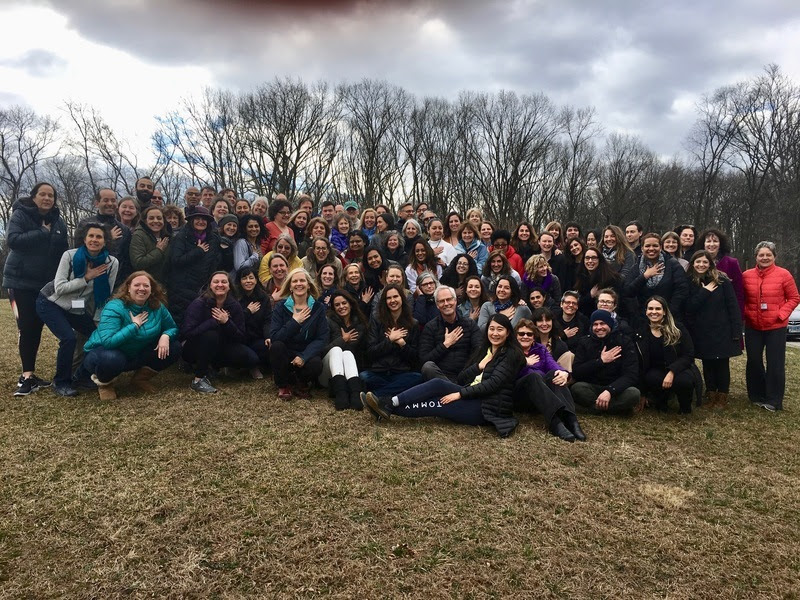
Our last day together at the intensive mindful self-compassion retreat
Although I don’t have space to give a full synopsis on the training, here are the highlights that stuck with me:
Compassion feels more deserved when I’m offering it to others than when I’m offering it to myself.
Finding the right compassionate phrases to offer yourself is incredibly important for self-compassion to feel true.
There are two types of compassion: the Yin, which offers more caretaking and comforting support, and the Yang, which is more fierce and protective support and motivated towards change. We need both comfort and protection when we’re suffering. Both together are a fierce, caring force!
Using tender, compassionate touch, such as a hand on your heart or cheek, and a soothing voice helps to reinforce and internalize the compassionate messages we offer ourselves.
Tuning in to our physical response to stress and distress helps identify where to offer ourselves soothing touch.
The number-one block for people around the idea of self-compassion is that it will undermine motivation. But the research shows that a self-compassion practice is a better motivator than self-criticism!
There can be a back-draft effect from self-compassion. As we offer ourselves love and compassion, we might become aware of the times when we weren’t received with compassion. We can meet that pain with a mindful compassion for what we didn’t get.
It’s really important to have grounding skills in place and to be aware of self-care routines that help us feel nourished so we can manage when back-draft, resistance or traumatic memories show up.
Offering ourselves loving-kindness isn’t focused on fixing the problem or trying to make us feel better but because we feel bad.
Our critical voice often stems from the need for protection and safety. It wants to keep us from making mistakes, to keep us safe from others’ judgment, and to protect us from emotional harm.
Our compassionate voice can actually create emotional safety.
When we can embrace who we are with all of our imperfections and our human suffering, we are creating space for a radical acceptance.
Difficult emotions are a part of daily life. As we practice being mindful of our emotional and physical state, we can choose how to respond to those feelings. No choice is better or worse. It just depends on where you are in that moment. We can:
Resist them
Be curious about them
Tolerate them
Allow them
Befriend them
Self-compassion takes practice. The goal is not to be perfect at compassion but to be a compassionate mess!
It’s also important to know that mindful self-compassion can trigger traumas that we might not be aware of. If you decide to practice self-compassion and it feels more distressing than helpful, take some time to ground yourself, provide self-care in ways that are meaningful to you and seek professional help with a therapist for support and to explore alternative ways to keep you grounded in your practice if needed.
Elizabeth Cush on Self-Compassion
If you enjoyed this blog post and would like more insights into living with anxiety, tune into the Woman Worriers podcast. In each weekly 30-minute episode, host Elizabeth Cush, LCPC, and her guests explore living with anxiety, relationships, parenting, surviving trauma and other topics and offer insights into mindfulness, meditation and other helpful resources.
Elizabeth Cush, LCPC is a therapist, blogger, creator and host of the Woman Worriers podcast, and the owner of Progression Counseling in Annapolis, Md and she’s been featured in these major publications. Elizabeth helps busy, overwhelmed men and women manage their anxiety and stress so they can live their lives with more ease, contentment and purpose. If you'd like to know more about how individual, online and group therapy can help ease anxiety and stress, contact me!

Tired of anxiety and stress ruling your life? Are you ready to live with more ease and purpose? Start with your free Worried Woman’s Guide to Meditation here.
We’ll also let you know about the newest Awaken Your Wise Woman podcast episodes and Elizabeth’s Blog posts, delivered right to your inbox. Just fill out the form and you’re in!